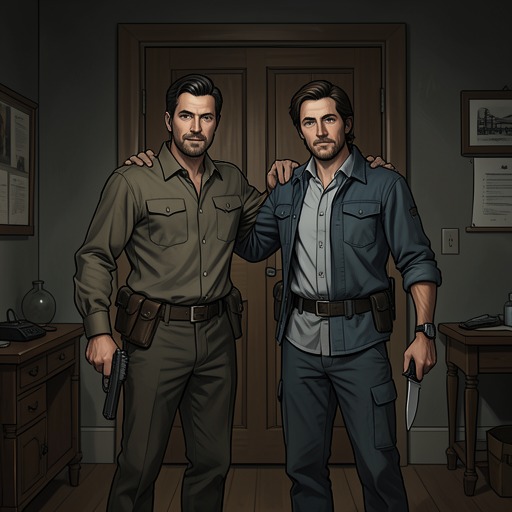
The Smiths' House Shootout and Reconciliation
Mr. & Mrs. SmithThe Smiths' House Shootout and Reconciliation is the turning point at which Jane Smith and John Smith’s professional violence becomes a direct reckoning with their marriage. Their gunfight wrecks the home that had contained their carefully managed domestic life, but at the moment when either could kill the other, both falter. The destruction does not resolve their conflict by force; instead, it exposes the attachment that survives beneath it and makes reconciliation possible.
Causes and Domestic Stakes
The confrontation unfolds against a history in which marital friction and the couple’s concealed professional lives have occupied the same domestic spaces. A request for unsalted butter becomes a small emblem of that friction: John brings the salted kind, Jane points out the mistake, and he privately casts himself as a knight sent on an impossible errand by an ice princess. Her attempt to change the subject to new living-room curtains does not erase the irritation; the mundane exchange gives their later violence an intimate vocabulary. Their conflict is not only about rival agencies or weapons. The house is also the setting of accumulated expectations, resentments, and shared memories.
Each spouse’s covert habits have already made ordinary household fixtures part of a second life. Jane stores sleek weapons and polished knives in the oven, having recognized that John cannot even boil water and would not suspect the kitchen. John, meanwhile, discovers her hidden arsenal in the shed: guns of many kinds, stacks of cash in different denominations, and foreign currency. The domestic setting is therefore not a refuge from their work but a place where both have concealed its material evidence. In the later confrontation, those concealed identities surface inside the home they once treated as a shared life.
The episode’s tonal collision is visible even before the shooting. Jane’s preparations for the dinner include planning the menu, choosing the dishes and tablecloth, and considering whether to buy flowers. She wants one last evening to be perfect before everything falls apart. That wish for domestic order stands beside the couple’s professional readiness for violence: at home, a hidden oven compartment holds weapons, while in the shed an entire armory waits beneath a floor hatch. Domestic care and lethal capability are not separate modes of life here; they occupy neighboring rooms and sometimes the same conversation.
The House Becomes a Battlefield
When John approaches the house, Jane appears at the back door with her hair blowing in the wind, eyes flashing in the moonlight, and a semiautomatic rifle in her arms. The stance is a challenge, and John freezes. The familiarity of the setting makes the encounter more than a professional ambush: the person barring his way is his wife, defending the home with the competence of an experienced agent.
John nevertheless enters by the basement, cuts open the storm door, and goes to his hobby room. There he opens a concealed wall panel and takes a silenced pistol, ready for use. The carefully hidden weapon turns another private room into an operational cache. Its silencer is chosen with a domestic joke about not disturbing the neighbors, even as the couple’s fight is about to shatter the house’s quiet and its contents.
Jane fires first as John moves through the hall. The burst tears into the wall, breaking framed photographs and a lamp; the damage reaches the visible record of their shared life before the spouses have even met face to face. John answers with gunfire of his own as he moves toward the dining room. Glassware explodes, cabinets fly open, and Jane’s beloved teapot and kettle are hit. She pauses to stare at the ruin of her favorite room, then turns back toward him in fury. The attack converts domestic possessions into casualties of a fight that began with the marriage itself.
From Gunfire to Hand-to-Hand Combat
After the kitchen is wrecked, the fight moves beyond marksmanship into a struggle for control. John attacks and grabs Jane’s weapon; they grapple as rounds fly, tearing up the room around them. Jane finally drives him down with an elbow strike. As he falls, she draws two revolvers crosswise, in the manner of a Western villain, and connects this renewed threat to the earlier domestic grievance: John had made her angry over the curtains. The joke does not soften the danger; it shows how the couple’s household quarrels persist even when their weapons are trained on each other.
The violence escalates into an ugly, close-quarters brawl. Elbows and knees land, bones crack, bruises form, and the pair crash into furniture and walls, destroying rooms they once took care of. The narrative explicitly distinguishes this fury from an ordinary contest between rival agencies: professional territorial conflict cannot account for the personal force of their attack. Jane wants to kill her husband, and John appears equally intent on killing his wife. Their shared home, already stripped of photographs and domestic objects, becomes the physical measure of how far the marriage has come apart.
The Choice to Stop
The fight reaches its decisive point when Jane and John stand only inches apart, each holding a weapon on the other and both with fingers on the trigger. Around them lie the remains of the marriage as well as the wreckage of the rooms: broken photographs, torn fabric, and fragments of treasured memories. For a moment, neither fires. Then John’s shoulders relax and his weapon drops. Jane asks what he is doing; he lets the gun fall beside him and tells her to go ahead. His surrender turns the scene from a contest of who can outshoot the other into a test of whether either can carry out the killing.
Jane cannot. Her finger leaves the trigger and the weapon falls from her hand. She recognizes that she cannot kill John, even when he is close enough to be killed with a single shot. As she falters, John catches her in his arms, and the embrace becomes a hungry kiss. The reversal is physical and immediate: the bodies that had just tried to overpower and destroy one another now hold each other. Their reunion does not undo the gunfire or repair the house, but it reveals that the violence has not erased their attachment.
Reconciliation and the Damaged Home
Afterward, their exchange keeps the danger and intimacy together. John gestures at her heart with a finger as if it were a weapon and admits that he should have killed her long ago; Jane answers by inviting him to kill her again. They kiss at length, and Jane begins to giggle as she imagines what the neighbors would think if they saw the couple’s supposedly perfect home. The joke makes the wreckage part of their renewed intimacy: the facade of domestic perfection is gone, but they can face its collapse together.
The scene’s resolution is therefore neither a clean victory nor a return to the old household. Jane and John stop short of killing each other, and their choice opens the possibility of a life beyond the marriage’s immediate crisis. The broken photographs, ruined rooms, and abandoned weapons remain the material cost of their confrontation. Yet the couple’s final laughter and kiss shift the meaning of the house: it has been both a battlefield and the place where they remember that they still choose one another.